Showing posts with label multipart. Show all posts

2018-01-25

PowerShell Core 6.1 Web Cmdlets Roadmap

2018-01-25-01

Intro

Recently the PowerShell Team published their PowerShell Core 6.1 Roadmap. Several questions have come up about 6.1 plans for Invoke-WebRequest and Invoke-RestMethod. You may have noticed there is no mention of the Web Cmdlets in their roadmap. That is because the majority of the feature work for the cmdlets is being done by yours truly. As I am a community member and not a Microsoft employee, it would make sense that my work is not included in their blog. Anyway, I felt it was a good idea to share what I have in store for the next 6 months.

I should warn that this is more accurately called "Mark Kraus's PowerShell Core 6.1 Web Cmdlets Wish List" rather than a roadmap. I only have 2 features that are pretty much approved. The rest will depend on whether or not the changes actually get accepted. Also, I'm not part of any team working on this. It's just me and the issue queue back log of feature requests and bugs. If your company wants to hire me to work full time on the Web Cmdlets, then hit me up. Otherwise, this is all a side project for me and life happens. So please don't hold me to any deadlines! :)

2017-12-24

PowerShell Core Web Cmdlets in Depth (Part 3)

2017122401

Part 3 Intro

In Part 1, I covered the primary changes in the actual code base of the PowerShell Core Web Cmdlets Invoke-RestMethod and Invoke-WebRequest and how those changes manifest themselves in the PowerShell user experience.

In Part 2, I covered outstanding issues as well missing and/or deprecated features.

In Part 3, I will cover new features available in PowerShell Core 6.0.0 Invoke-RestMethod & Invoke-WebRequest. I will also cover future plans for the cmdlets.

If you have not read Part 1 and Part 2, please do so before reading Part 3. This blog series goes in depth and requires a great many words to do so. To save space I will not repeat some information and will assume the reader as read Part 1 and Part 2.

A quick bit of news: PowerShell Core v6.0.0-rc.2 was released. Unless any blocking issues are discovered, this will be the final RC release and the next release will be GA in January 2018.

2017-09-24

Multipart/form-data Support for Invoke-WebRequest and Invoke-RestMethod in PowerShell Core

20170924_blog
Pictured: A packet capture of a current build of PowerShell Core submitting a multipart/form-data POST request from Invoke-WebRequest.

Intro

Over the past few months I have been donating a generous portion of my spare time to help improve the Web Cmdlets (Invoke-WebRequest and Invoke-RestMethod) in PowerShell Core. This is partly because I want and need certain functionality for both personal and work related projects. It is also because I have had some minor gripes about these Cmdlets for some time.

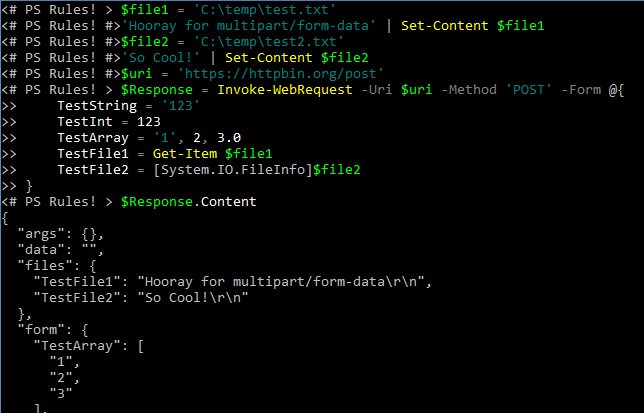
One common ask I have seen repeated in just about every PowerShell forum is multipart/form-data support. It seems like a reasonable thing to ask when there are many endpoints that will only work with a multipart/form-data submission. There is an open issue (#2112) on the PowerShell GitHub echoing the same request. It was brought to my attention and I decided to give it a serious look.

The result is that PowerShell Core now has partial multipart/form-data support in both Web Cmdlets. This change didn't make the cut for 6.0.0-beta.7 but it will be available starting in 6.0.0-beta.8 and is available now if you build it manually or grab the latest nightly build.

This blog will cover some of the challenges involved in supporting multipart/form-data, how to make use of this new feature, and about future plans for additional support.

Because typing multipart/form-data is annoying, I will be shortening it to just multipart. Please don't let this be mistaken for other multipart submission methods.

Also, I will be referring collectively to Invoke-WebRequest and Invoke-RestMethod as Web Cmdlets. In this case, there is no need to call out each command as they offer the same base functionality for multipart support.